
How Arkansas People Search Starts
Arkansas records are layered. The state runs major portals such as Search ARCourts, VoterView, the Department of Health vital-record selector, the Secretary of State business search, the Department of Corrections inmate search, and the ACIC sex-offender registry. County offices still hold the deed books, assessor rolls, voter lists, marriage licenses, probate files, jail rosters, and many old records that never became part of one statewide search.
The best Arkansas people search path depends on the first known fact. A name works well in court, business, license, property, archive, and unclaimed-property searches. An old address points toward assessor rolls, GIS viewers, deeds, city directories, and newspapers. A family link points toward vital records, probate, obituaries, cemeteries, and the Arkansas State Archives.
- Search the person's name in Search ARCourts, then note case numbers, counties, and parties.
- Check assessor and deed tools such as actDataScout or ARCountyData for owner names, mailing addresses, and parcels.
- Use VoterView only when the required name and birth-date details are known and the search is lawful.
- For family history, move to ADH rules, obituaries, probate, Arkansas Digital Archives, and library directories.
- When no portal shows the record, ask the custodian under the Arkansas Freedom of Information Act.
Arkansas Records Offices for Search
Arkansas does not have one master people-search office. The state office may hold the index, while the county or local clerk holds the file. Circuit clerks often serve as ex officio recorders for deeds and liens. County clerks process voter registration and marriage licenses. Assessors maintain parcel cards, while collectors and the Commissioner of State Lands handle tax trails. State agencies handle vital records, business filings, state inmates, licenses, and archival collections.
Arkansas Vital Records
4815 West Markham Street
Little Rock, AR 72205
Online, mail, and in-person orders
Arkansas State Archives
One Capitol Mall
Little Rock, AR 72201
state.archives@arkansas.gov
Arkansas Secretary of State
Business and Commercial Services
Little Rock, AR
State business filings
Arkansas People Search by Clue
Each clue belongs to a different record trail. A current address may be a situs address, which means the physical parcel. A mailing address can be more useful because it shows where tax bills go. A docket is the court's event list for a case. A disposition is the case outcome. A grantor is the person giving an interest in a deed, and a grantee receives it.
| Starting Clue | Best Arkansas Source | What It May Show | Fallback |
|---|---|---|---|
| Name | Search ARCourts, SOS, license boards | Case, agent, license, or filing links | County clerk or board request |
| Address | Assessor, GIS, deed index | Owner, parcel, mailing address | County assessor or recorder counter |
| Family event | ADH, probate, archives | Birth, death, marriage, divorce, estate clues | County court file or State Archives |
| School or public role | ADE and staff directories | Work title, agency, phone, email | Department main office |
| Old residence | CALS, city directories, newspapers | Address, occupation, spouse, year-to-year moves | Local library or archive |
Arkansas Court Name Lookup
The Arkansas Judiciary's Search ARCourts portal is the main statewide web entry for public case information from courts using the Contexte case-management system. It replaced the older CourtConnect experience for many users. A participant search can point to civil, criminal, probate, domestic, traffic, and district-court matters when the court participates and the record is public.
The AOC help page notes the move from Public CourtConnect to Search ARCourts. Web results are not the full case file. Arkansas Supreme Court Administrative Order No. 19 controls access to court records, so sealed cases, juvenile and adoption material, protected identifiers, and some family-law details may be hidden. The clerk where the case was filed remains the source for file copies, certified dispositions, and older records.
| Search ARCourts Field | Type | Use | Limit |
|---|---|---|---|
| Participants | Mode | Search by person or business name | Only participating public data |
| Case Number | Mode | Direct lookup when known | Exact number needed |
| Court or Location | Filter | Narrows common names | Filter set varies |
| Case Type or Date | Filter | Separates civil, probate, criminal, traffic, and time periods | Older files may be offline |
The Search ARCourts screen shows why a name search should be paired with county and date clues.
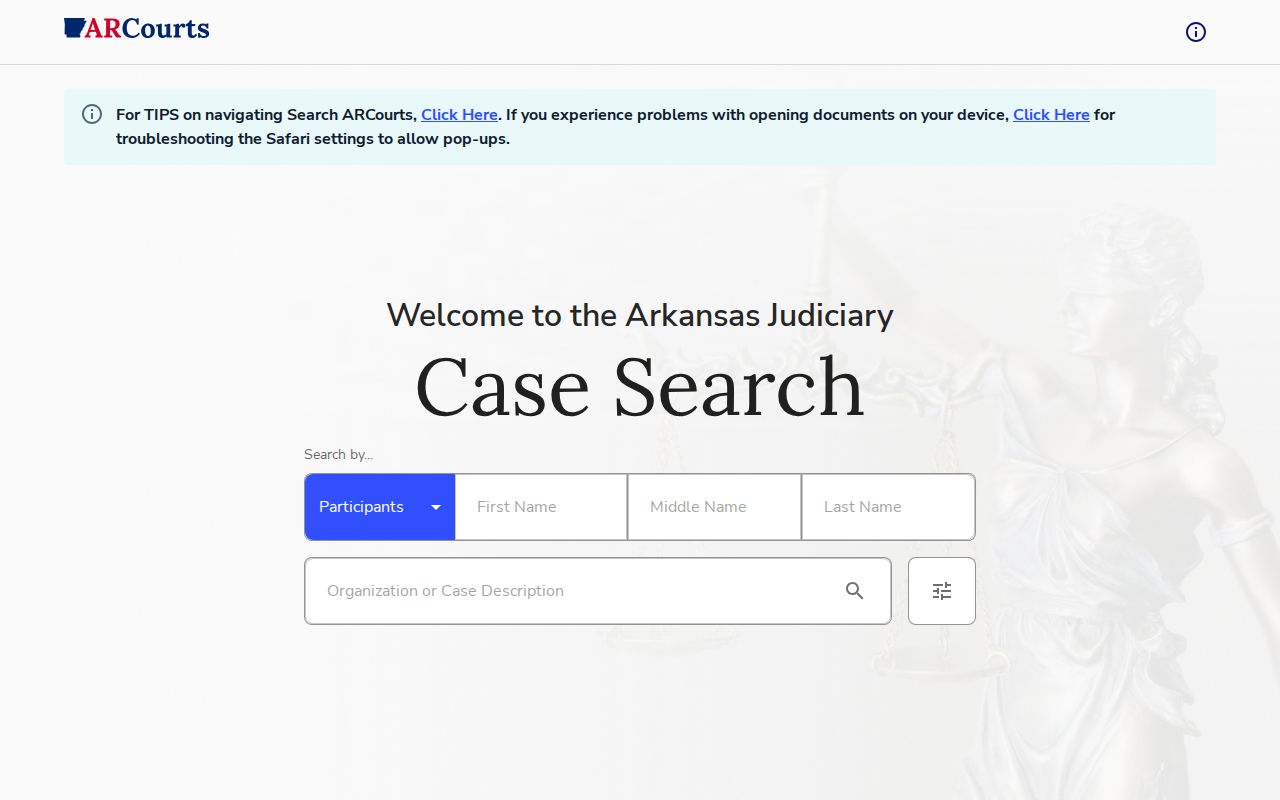
When the web record is thin, the circuit or district clerk can explain terminal access, copy rules, and sealed-record limits.
Arkansas Property Mailing Clues
Property data is often the strongest current-contact clue in an Arkansas people search. County assessor cards can show owner name, mailing address, situs address, parcel number, legal description, tax district, value, sales history, and building data. The mailing address matters because it may differ from the property address and can point to an owner, heir, trust, or out-of-state contact.
Arkansas has no single complete free statewide assessor database. actDataScout covers many participating counties. ARCountyData covers assessor and collector records in many counties, advertises more than 75 search inputs, and lists account/minute pricing for many features. The Arkansas GIS Office map hub adds parcel, district, and city-boundary context, but GIS is not a deed or certified tax roll.
The actDataScout county public-record search is one statewide starting point for participating counties.
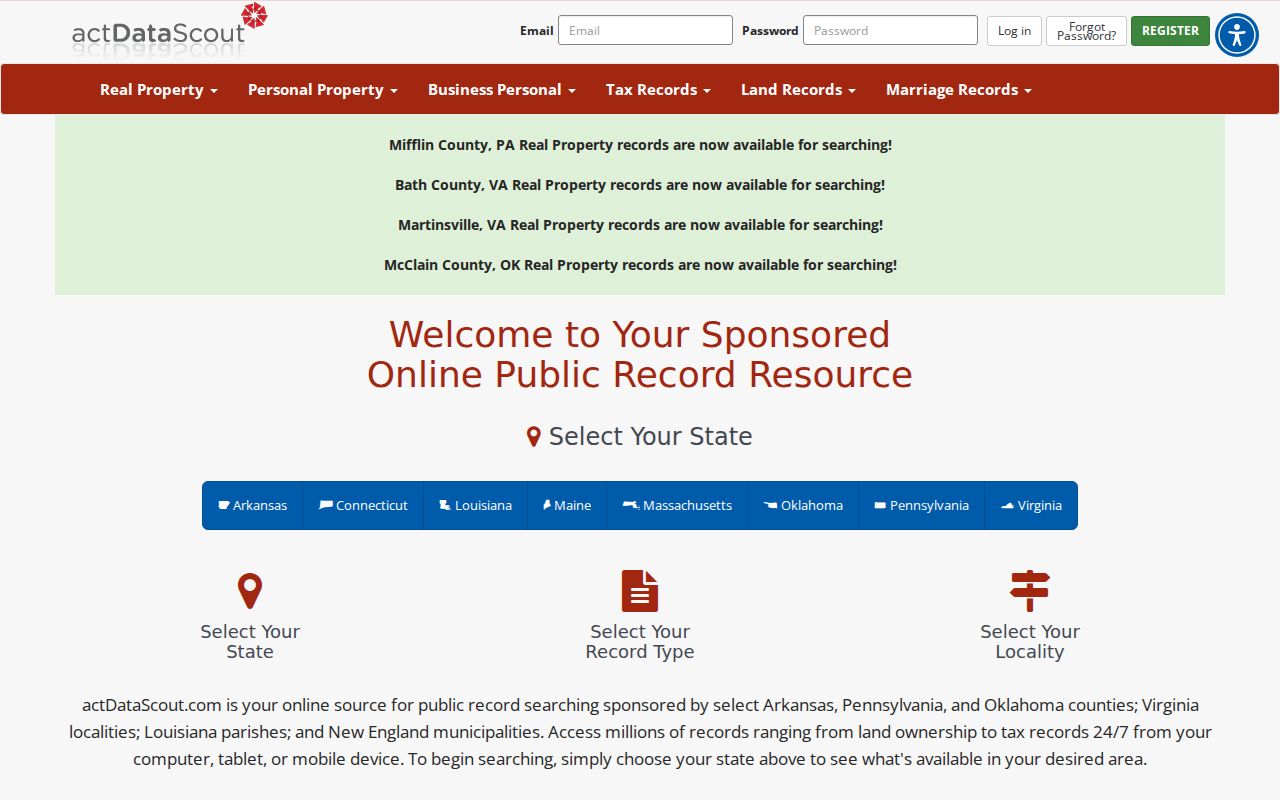
County coverage still controls what a user sees, so a missing actDataScout result should lead to ARCountyData or the county assessor.
Property clue. Treat the owner mailing address as a lead, not proof of residence. Protected addresses and trust or business ownership can change the trail.
Arkansas Vital Records Search Limits
Certified Arkansas birth, death, marriage, and divorce records come through the Arkansas Department of Health. Ark. Code Ann. § 20-18-305 makes birth records public after 100 years and death, marriage, divorce, and annulment records public after 50 years. Recent certified copies require eligibility, identity checks, and relationship or legal-interest proof.
Vital records are useful for family history, heir work, adoption-file procedures, and confirming life events, but the modern certificate is not a general people-finder file. Marriage licenses also involve county clerks. Divorce has both the circuit-court decree/file and the ADH state record. Older records may be found in county books, archives, church records, probate files, newspapers, and delayed birth registrations.
The ADH vital-record selector routes users by certificate type.
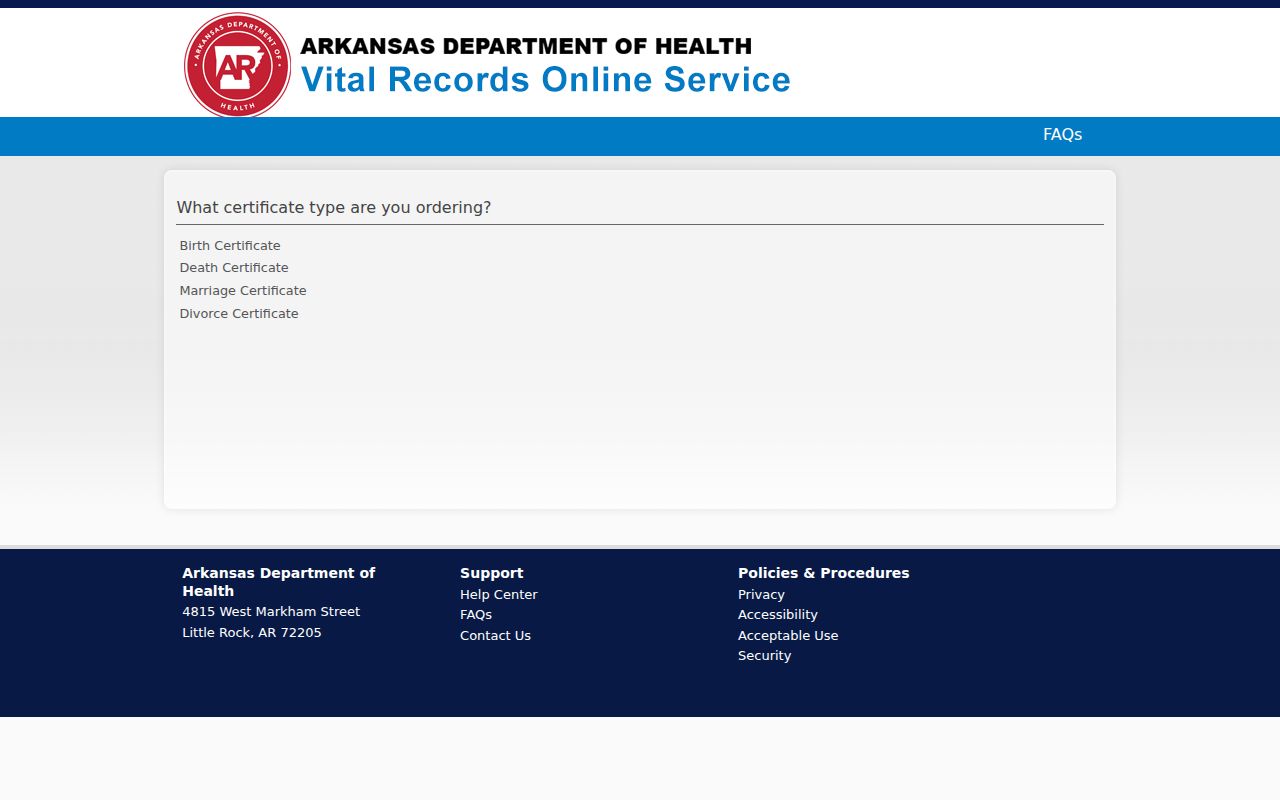
The selector is an order path, while historical research often needs the State Archives, county books, or local library collections.
Arkansas Voter Lookup Boundaries
VoterView is an Arkansas Secretary of State tool for checking registration details. It asks for first name, last name, and date of birth, and the voter information hub says it can confirm address, party association, ballot statuses, and polling place locations. It is not a browse-all-voters directory.
County clerks are the local voter-registration custodians. Ark. Code § 7-5-109 allows county clerks to reproduce registered-voter lists in formats their offices can provide, with fees tied to reproduction expense. The same statute protects secure-voter addresses from reproduction unless law allows it. Full voter-registration handling belongs on the Arkansas voter registration records page.
Arkansas Business and License Records
Business and license records can identify people through registered-agent names, principal offices, managers, license status, board rosters, and practice addresses. The Arkansas Secretary of State business search covers corporation, LLC, nonprofit, cooperative, bank, insurance company, fictitious-name, registered-agent, RA city, and filing-number searches. Professional lookups are split among boards.
The Secretary of State Business Entity Search is a direct name and agent search.
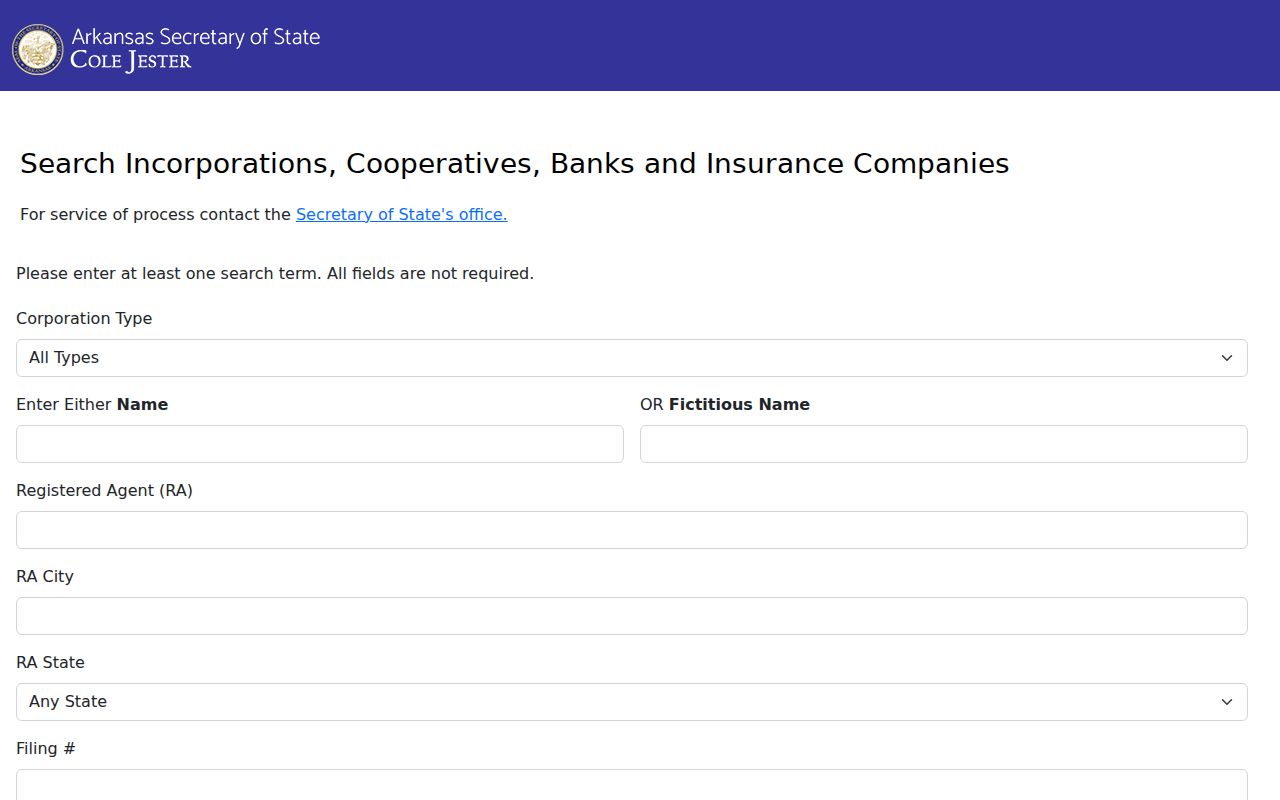
Business records work best when paired with court, property, license, or unclaimed-property results because each source uses a different naming convention.
- Registered agent
- The person or company designated to receive legal notices for an entity.
- Fictitious name
- A registered business name used apart from the legal entity name.
- Primary-source license
- A license record verified by the board that issued or maintains it.
Arkansas Inmate and Registry Search
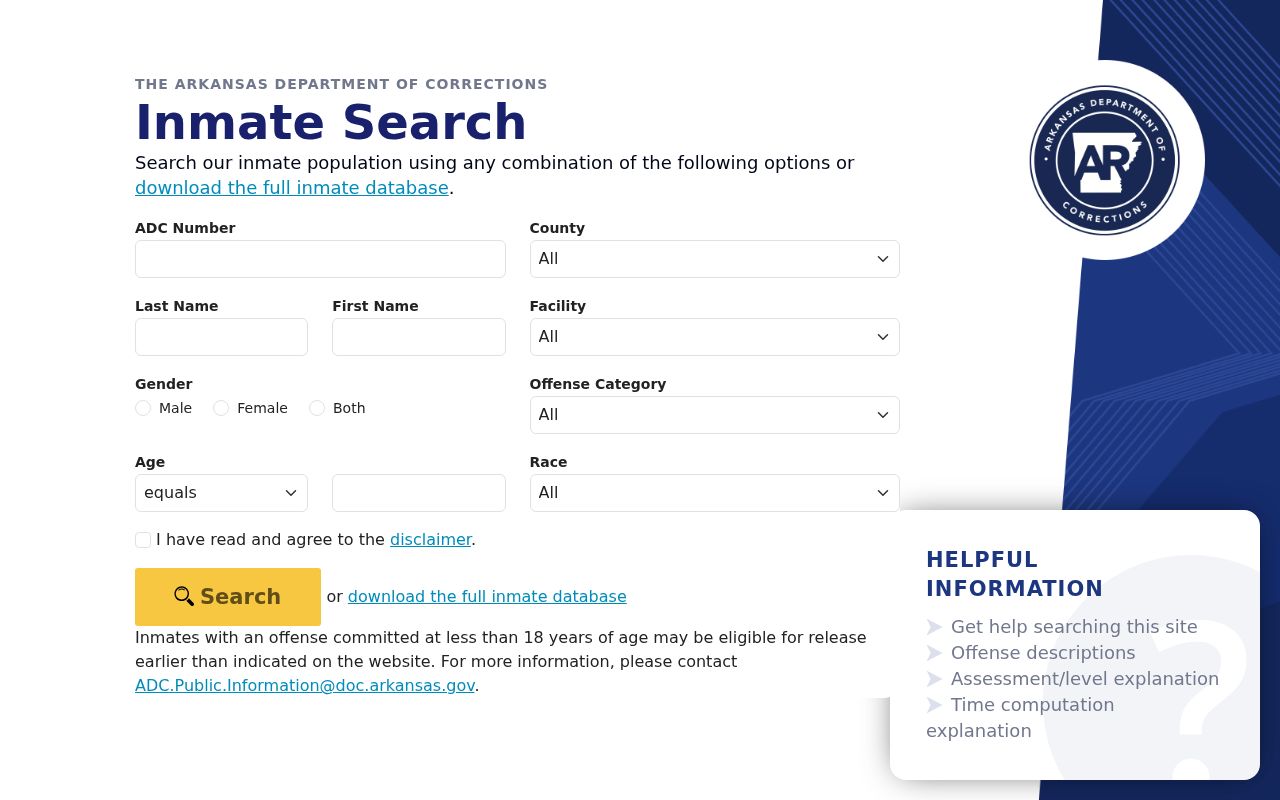
State custody and registry sources are separate from county jail rosters. The Arkansas Department of Corrections inmate search can be searched by ADC number and other criteria, and DOC notes a downloadable inmate database. County sheriffs publish local rosters, but there is no single statewide county-jail roster. Arkansas County, Washington County, Saline County, White County, and other sheriffs have their own formats and retention windows.
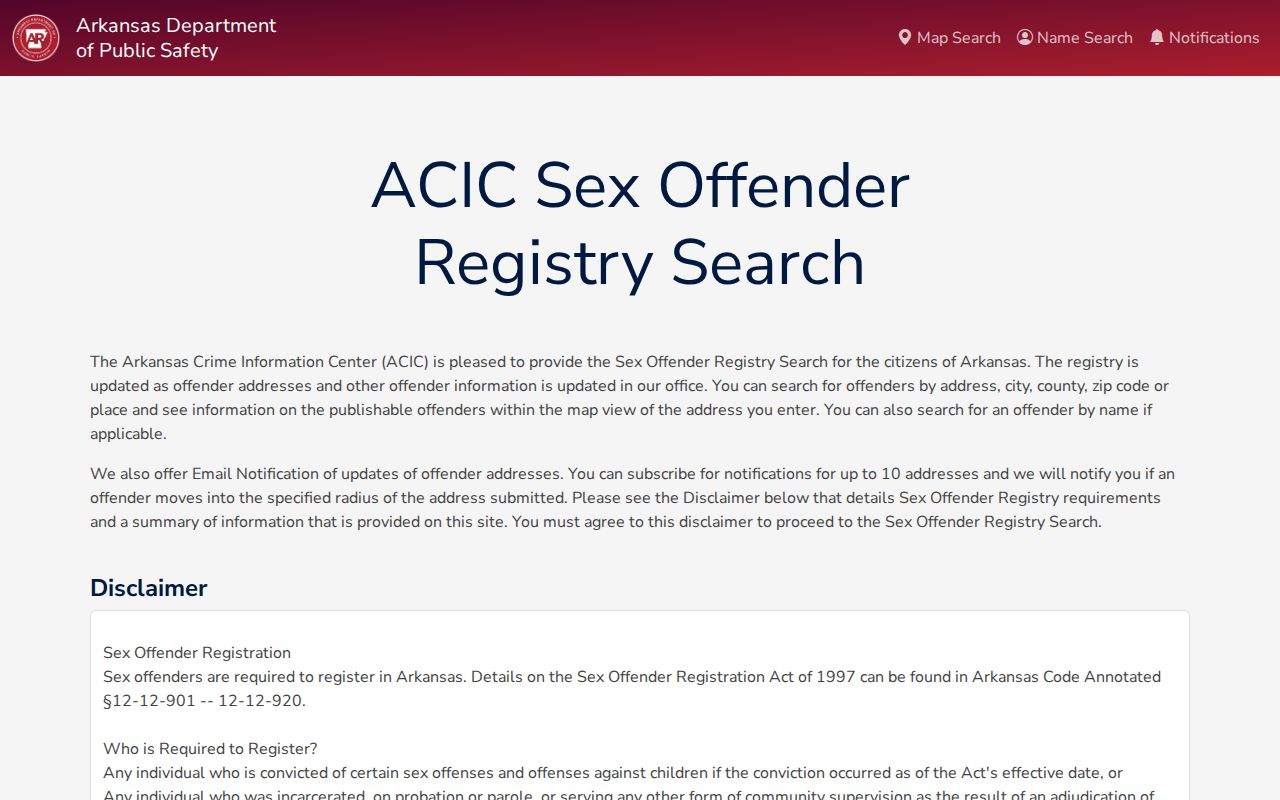
The ACIC public registry is a separate public-safety search for publishable sex-offender records by address, city, county, ZIP code, or name. It does not mean every law-enforcement file is public. Juvenile, sealed, victim, and active-investigation records may be restricted.
The Arkansas DOC inmate search is the state custody starting point.
For county custody, move from the state search to the sheriff in the county where the booking occurred.
The ACIC public registry offers address and map-based searching.
Registry information should be used only for lawful personal-safety and civic purposes, never to harass or threaten anyone.
Arkansas Archives and Old Residents
Historical Arkansas people search often leaves the modern portals. The Arkansas State Archives preserves more than 200 years of Arkansas history, and the Arkansas Digital Archives includes territorial, county, military, court, map, newspaper, photograph, and government-record materials. Finding aids expose collection titles, dates, creators, subjects, and container descriptions.
CALS Roberts Library and the Butler Center are especially useful for city directories, yearbooks, newspapers, property-history worksheets, Ancestry Library Edition, Newspapers.com, Fold3, HeritageQuest, and Fire Insurance Maps Online. City directories can show names, addresses, occupations, spouse or widow notes, and year-to-year moves. Reverse directories can start from an address and identify occupants or nearby households.
When no digital item appears in an archive search, a finding aid can still point to a physical county record group or manuscript collection.
Arkansas Record Gaps and Fires
Arkansas became a state in 1836, but county boundaries, courthouse fires, and archive transfers affect where older names appear. Washington County land records begin in 1834, and its courthouse burned in 1862, yet officials had moved records to Fincher's Cave, preserving many early records. Izard County's 1889 courthouse fire destroyed records at the courthouse. Sharp County had an 1880 fire that destroyed county records.
Those stories matter for a modern Arkansas people search. A missing county record may mean the search needs parent counties, substitute records, newspapers, church registers, probate, land patents, tax lists, or archive holdings. Arkansas County offers another digitization example: its online document search notes data from 1995 forward, images from 2005 forward, and updates every 30 minutes.
Arkansas Heir and Unclaimed Search
Heir searches often combine death records, obituaries, probate, deeds, estate transfers, tax delinquency, and unclaimed property. The Auditor of State runs the Great Arkansas Treasure Hunt through ClaimItAR.gov. It can list owner names and last-known addresses for accounts, wages, stocks, utility deposits, insurance proceeds, cashier's checks, money orders, and safe-deposit contents.
The Auditor moved the program to ClaimItAR.gov on Feb. 1, 2024, a timely change meant to make the state claim path clearer. For tax-delinquent land, the Commissioner of State Lands search can show owner names and parcels, but the agency warns that paying delinquent taxes does not give ownership when the payer is not already the owner. That warning is important for estate, heir, and property-curiosity searches.
Official Arkansas Search vs Aggregators
Commercial people-finder services compile public records, marketing data, phone data, and brokered files. The data can be stale, mismatched, or incomplete. Official Arkansas records have narrower search screens, but they identify the custodian, the record source, and the legal limits. That makes them better for verification.
| Source Type | Strength | Weak Point | Best Use |
|---|---|---|---|
| Official court, deed, assessor, and agency portals | Custodian-backed records | Not always statewide or complete online | Confirming a real record trail |
| Libraries and archives | Older residents, newspapers, directories | May require in-person or copy requests | Family history and old-address work |
| Commercial people-finder category | Broad compiled hints | Can be wrong or outdated | Leads that must be checked with official records |
Lawful use only. Arkansas records may not be used to stalk, harass, threaten, or harm a person. Verify important facts with the record custodian.