
Arkansas Voter Registration Lookup
The Arkansas Secretary of State points voters to VoterView, the public-facing lookup for registration information. The tool is built around a matched registrant search. It asks for personal fields and returns details only when the entered information matches a voter record. VoterView can also search polling place information by residential address.
The Arkansas SOS voter-information hub links registration, polling place, form, and voter lookup resources.
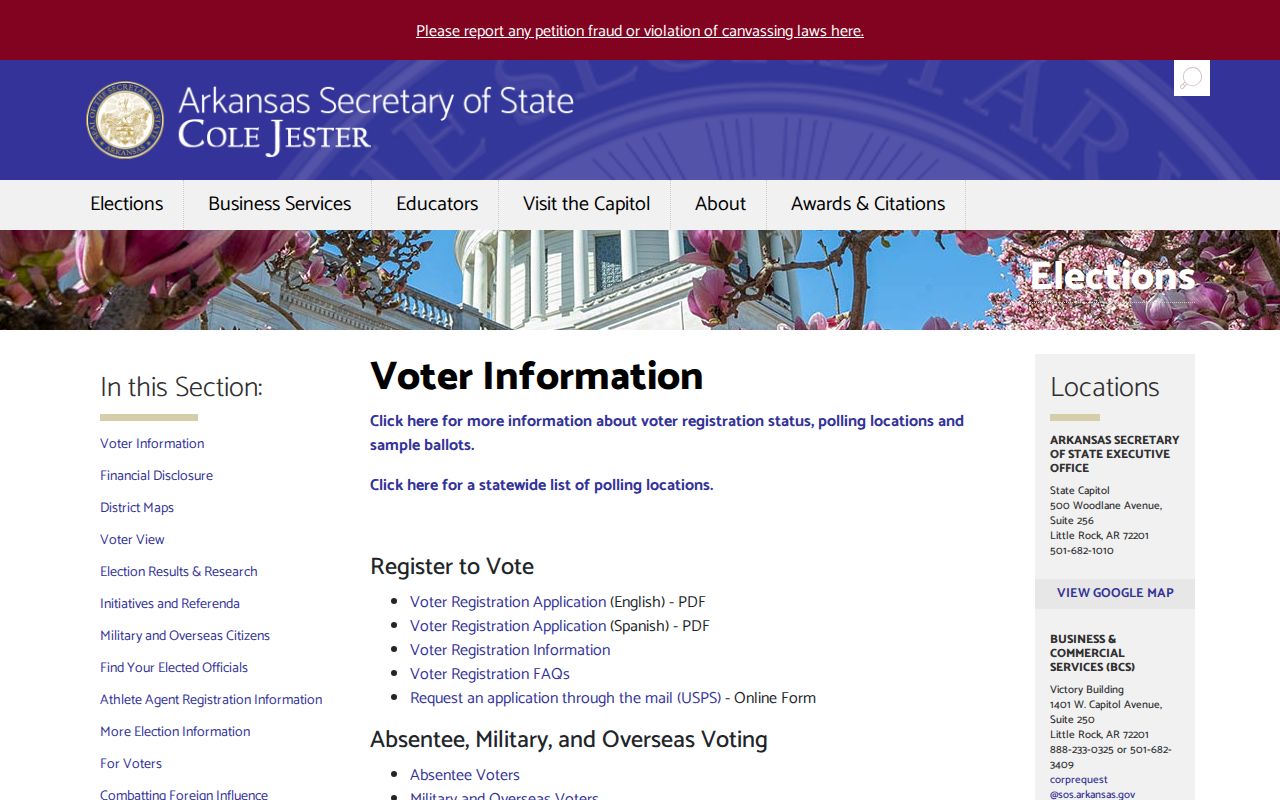
The hub is the better starting point when a user needs forms or county-clerk guidance, while VoterView is the direct lookup tool.
| VoterView Field | Type | Required | Notes |
|---|---|---|---|
| First Name | Text | Yes | Registrant first name. |
| Last Name | Text | Yes | Registrant last name. |
| Date of Birth | Date | Yes | Required to match the registrant. |
| Residential Address | Text or autocomplete | For polling-place search | Used to find polling place information. |
| Language | Link or selection | No | English and Spanish links are visible. |
When Arkansas VoterView Fails
VoterView has specific error messages. "Missing Registrant Search Fields" means all required fields were not entered. "No Matching Registrants" means the data entered did not match a registrant in the tool. A non-match does not prove the person is not registered. It may reflect spelling, date-of-birth entry, a recent application not yet processed, a county update delay, or a name or address change.
The SOS voter-registration materials warn that submitting an application does not guarantee registration. The voter should receive acknowledgment from the county clerk. That county acknowledgment matters because the clerk processes the local registration record.
Lookup tip. Treat a failed voter registration search as a prompt to verify spelling, birth date, county timing, and county-clerk processing.
What Arkansas Voter Records Show
Arkansas voter registration records can include the information needed to administer elections and maintain the voter roll. VoterView says it can confirm address, party association, ballot statuses, and polling place locations when a match is found. County records and voter-list products can contain more administrative fields, but confidential numbers, protected addresses, and ballot choices are not public list material.
| Name | Used in lookup and registered-voter list records. |
|---|---|
| Residence Address | Ordinary list field, except secure-voter addresses are protected. |
| Mailing Address | May appear in county records if provided, subject to restrictions. |
| Date of Birth | Used for lookup; full DOB should be treated as sensitive. |
| Party Association | VoterView says it confirms party association when applicable. |
| Status | Active, inactive, cancelled, and similar election-system status fields. |
| Participation History | Can show that a voter participated in an election, never ballot choices. |
Confidential by law. Ark. Code § 7-5-109 protects secure-voter addresses from reproduction unless authorized. ID numbers, Social Security numbers, driver-license numbers, and ballot choices are not public voter-list data.
Arkansas Registration Application Fields
Arkansas registration is by paper application. The official application collects name, residential address, mailing address if different, date of birth, optional phone and email fields, Arkansas driver-license number or last four Social Security number, or a checkbox stating neither is available. It also asks about citizenship and age qualifications, prior registration, name or address changes, party association where applicable, signature, date, and assistance information when someone helps the applicant sign.
The captured Arkansas online vital-record order flow in the manifest is not a voter-registration source, but it reflects how state identity workflows require proof and eligibility for restricted records.
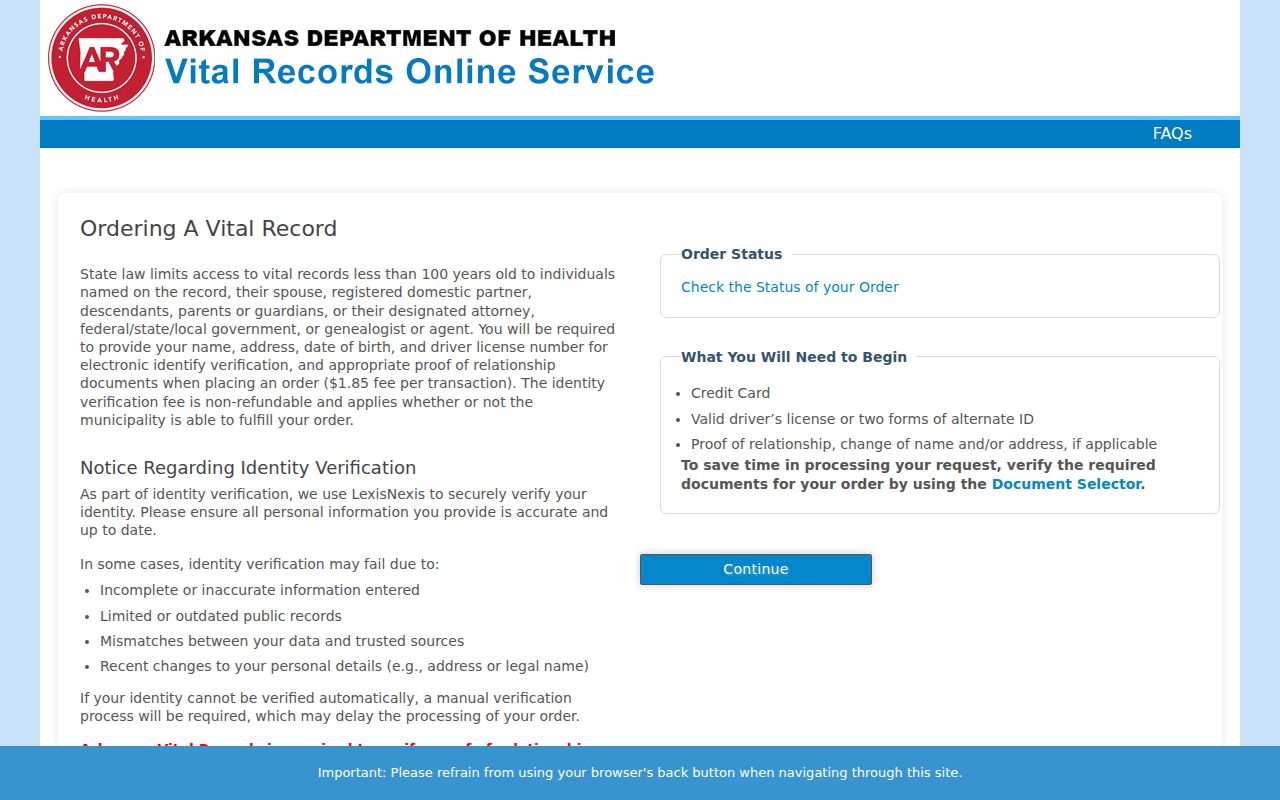
For voter registration itself, the paper application and county clerk are the controlling route.
County Clerks Hold Voter Records
County clerks are the local custodians for Arkansas voter registration records. They process registrations, updates, transfers for address changes, absentee-ballot requests, and voter registration data. Pulaski County's Voter Registration Department is one example of the local role, but each county handles its own office process.
Voters must register at least 30 days before Election Day. If a voter moves from one Arkansas county to another, SOS voter-rights material says the updated registration must be in the new county clerk's office by the fourth day before the election. Those timing rules explain why a recent application or transfer may not appear in a lookup at once.
Getting the Arkansas Voter File
The full voter registration list is a county-clerk product under Ark. Code § 7-5-109, not a single ordinary-user statewide bulk download found in the research. County clerks may reproduce the registered-voter list in any format their office can provide. They may charge a fee that reimburses reproduction expenses, but the value of existing office equipment is not part of that fee.
- Identify the county whose voter list is needed, then contact that county clerk.
- Ask for the list date, fields, format, precinct or district filters, and delivery method the clerk can provide.
- Confirm the reproduction-cost fee and whether the request should be submitted in writing, by email, or in person.
- Expect secure-voter addresses and sensitive identifiers to be excluded.
For general public-records request rules outside this specific voter-list statute, use the Arkansas FOIA discussion on the Arkansas public records page.
Arkansas Secure Voter Limits
Arkansas has more than one privacy layer. Voter-list law protects secure-voter addresses. Separately, Arkansas has a limited driver-license address confidentiality process under Ark. Code Ann. § 27-16-811 for qualifying domestic-violence victims and dependents. That process can allow a driver's license or ID to show a post-office box instead of a residence address after statutory steps are met.
This is narrower than broad substitute-address programs in some states. It does not make every public record private. It does mean voter registration records must be handled with care, and protected addresses should never be pursued through other record sets as a workaround.
Arkansas Voter List Maintenance
Voter registration records change. A record may become inactive or cancelled after death notices, felony disqualification where sentence is not discharged or pardoned, mental-incompetence adjudication, duplicate registrations, address confirmation, or a move out of the county or state. A voter lookup result is a point-in-time election record, not a permanent identity file.
On Jan. 9, 2026, the Arkansas Secretary of State announced that the office identified more than 1,000 duplicate voter registrations through the One State, One Vote initiative. That recent item shows why voter registration search results can shift as counties and the state update the rolls.
Historical Arkansas Voter Records
Older poll books, voter-registration registers, precinct voter lists, election returns, and county election materials may be held by county clerks, county archives, the Arkansas State Archives, or local libraries. They are useful for family history, neighborhood research, and tracing a person in a specific place and year. Retention and public access vary by county.
Search the Arkansas State Archives and Digital Archives by county, election, poll book, voter list, register, and precinct. Historical election records often need to be paired with census, city directory, deed, newspaper, church, cemetery, and probate records to separate people with the same name.
Voter Records Legal Use
Arkansas voter registration records are election-administration records. They should be used for lawful civic, personal, historical, and registration-confirmation purposes. The application warns that false information may subject a person to a fine up to $10,000 and imprisonment up to 10 years under state or federal law.
Misuse can also trigger broader laws. Arkansas harassment, harassing-communications, and stalking statutes restrict using information to follow, alarm, repeatedly contact, threaten, or harm someone. Voter registration data also never reveals ballot choices. Whether a person voted can be different from how that person voted, which remains secret.